

Contraception: Mini Pill, Injectable and Implant
The progestogen-only pill ('mini-pill')
The 'mini pill' is very suitable for older women with no upper age limit for use. It is thought to be used by 7% of women aged over 40 who are using contraception. As it does not contain estrogen, it can be used by women who are unsuitable for the standard combined contraceptive pill. Therefore, women with problems such as high blood pressure, migraines or who have had a previous thrombosis can use the 'mini pill'. Most ‘mini pills’ may however cause quite erratic periods or cause periods to stop altogether. The ‘mini pill’ contains progestogen only and it’s main contraceptive effect is by causing a thickening of the mucus at the neck of the womb, thereby making it difficult for sperm to travel into the womb. Recently, a ‘mini pill’ has become available which, as well as thickening the mucus, suppresses ovulation in about 97% of women. This is particularly helpful in women who are beginning to have irregular periods since many women on this preparation will not have periods at all. The progestogen only pill must be prescribed by a doctor but can be continued for as long as a woman requires contraception.
Injectable contraception
The three-monthly progestogen preparation contraceptive injection (Depo provera) is mainly used by young women. It can still be continued up to older ages and is a good treatment for heavy or painful periods and PMS (premenstrual syndrome). There is some current concern that contraceptive injections may increase the risk of osteoporosis in later life by reducing the ovarian production of estrogen. For this reason, many healthcare professionals recommend that women stop injectable contraception at the age of 45 years, and consideration should be given to using some other form of contraception if the injection has stopped periods for more than 2 years.
Implant
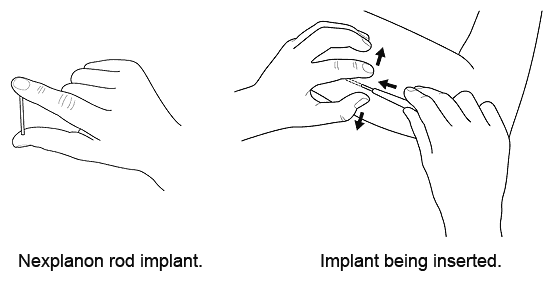
A contraceptive rod (previously Implanon but now replaced by Nexplanon) is also available which
is placed under the skin in the upper arm under local anaesthetic. This releases
progestogen in a steady level over 3 years. It is an extremely effective contraceptive
and does not seem to increase the risk of osteoporosis. Both the 3 monthly
injection and the 3 yearly rod are often chosen because of their convenience.